Das newBaC System kann dank vorbereiteten Geräten auf der Baustelle einfacher und schneller installiert werden. Es kann klassisch genutzt werden, sich aber auch elegant in IoT Systeme einbringen.
Demoschritte:
▶ Die farbigen / bescchrifteten Taster und Lampen sind installiert und sind sofort betriebsbereit
▶ Weitere Komponenten können über den Hotspot im Gateway installiert werden. Schalte ihn ein
▶ Installiere einen WAGO Dimmer und drücke dazu das "add Bulb" Menu im Mobile
▶ Integriere Apple Home für Spracheingane, Automatisierungen und Kontrolle über das Internet
▶ Der Mieter zieht mit seinem HomePod wieder aus und die Wohnung wird neu übergeben
Gateway's Hotspot
SW
Logic/ALG
A-Bridge
I-Bridge TBR
Light Living Sofa
Switch Light Sofa
HUE- Bridge
Light Living WAGO
Blinds Living South
Voice: Hey Siri,
Apple HomePod
Light WIZ
Light Living HUE
newBaC Gateway
Thread Infrastructure Network
WiFi
Zigbee
Die Demo zeigt:
▶ Die Installlation braucht keine Umwege über Schalter bei der Türe. Alle Geräte nutzen 24V DC.
▶ Thread Komponenten kommen ins Thread-Netzwerk und kommunizieren via den Matter-Gateway.
▶ Die Matter-ID des Devices wird benötigt und es kann zum Device auch eine Taste zugeordnet werden.
▶ Ein einziger Tastendruck geügt, um den HomePod ins installierte Thread Netzwerk zu bringen.
▶ Mit einem Tastendruck ist wieder die originale Installation mit neuer Sicherheit gültig.
newBaC - The Digital Infrastructure of Buildings:
newBaC is an open Smart Building Infrastructure Platform for residential buildings
and apartment developments. Instead of connecting isolated devices through proprietary
gateways and cloud services, newBaC creates a permanent building infrastructure that
connects lighting, shading, door communication, metering, tenant services and future
building applications through open standards and a common Building Directory Service
(BDS).
Building Directory Service (BDS) Just as DNS organizes the Internet, BDS organizes
smart buildings.
Building Infrastructure. newBaC combines: • KNX Integration • Matter over Thread
• Door Communication • Tenant Services • Future Building Applications within a
common infrastructure.
Controllers: • Access Controller • Apartment Controller for a scalable architecture
from single apartments to large residential buildings.
More newBaC Benefits:
• 24 V DC infrastructure throughout the building • Open Matter-over-Thread solution •
Open ecosystem integration • No app required • No LAN, WLAN or even cloud dependency
• Browser-based commissioning • Simplified tenant handover.
An Infrastructure Device is More than a Device:
Every newBaC device contributes to the building infrastructure. A single device
may simultaneously provide: • User interaction • Sensing • Matter connectivity
• Thread routing • Local automation • Building services. The result is a distributed and resilient building infrastructure.
No App Required:
Every gateway and infrastructure device provides: Temporary WiFi hotspot.
Integrated Web server for browser-based commissioning and tools.
A mobile phone becomes a secure transport medium for configuration data.
Designed for Building Planners:
Devices can be pre-configured according to the building plan, reducing commissioning
effort and accelerating installation significantly.
Open by Design:
newBaC infrastructure devices operate as standard Matter-over-Thread devices.
They can be integrated into: Apple Home, Home Assistant, other Matter ecosystems,
while remaining part of the permanent building infrastructure. No vendor lock-in.
Tenant Change:
Residents can bring and connect their preferred ecosystem. Their specific integrations
can be removed while preserving the original building configuration, when they leave.
The building remains unchanged. The ecosystem may change with the next tenant.
Vision:
Smart home should not belong to the tenant. It should belong to the building.
newBaC transforms lighting and automation from a collection of products into a permanent
digital infrastructure that remains stable for decades.
Smart Building Infrastructure Architecture
newBaC is an open Smart Building Infrastructure Architecture that connects KNX, Matter,
Thread, door communication, metering, building automation and future building technologies
through a common digital building model.
newBaC System Architecture stands for stable and deterministic infrastructure
with easyest integration of tenant's smart-Home extensions.
Connect Buildings, Not Just Devices:
Traditional smart home systems focus on individual devices. newBaC's open Smart Building
Infrastructure Platform connects buildings through a common digital building model and
scales from single apartments to large residential developments. BDS - Building Directory Service:
BDS organizes Buildings, Floors, Apartments, Rooms, Devices, Roles and Events
independently of the underlying technologies.
Just as DNS organizes the Internet, BDS organizes smart buildings. Built for Decades:
Buildings remain. Technologies evolve.
newBaC separates building structure from communication technologies, allowing future
systems to be integrated without redesigning the building.
The Building Infrastructure Platform scales
The newBaC open Smart Building Infrastructure Platform is designed for residential
buildings, apartment complexes and mixed-use developments.
newBaC enables scalable, future-proof and vendor-independent building automation.
The scalability of the technical reference architecture is illustrated with a 20storey
mixed-use building:
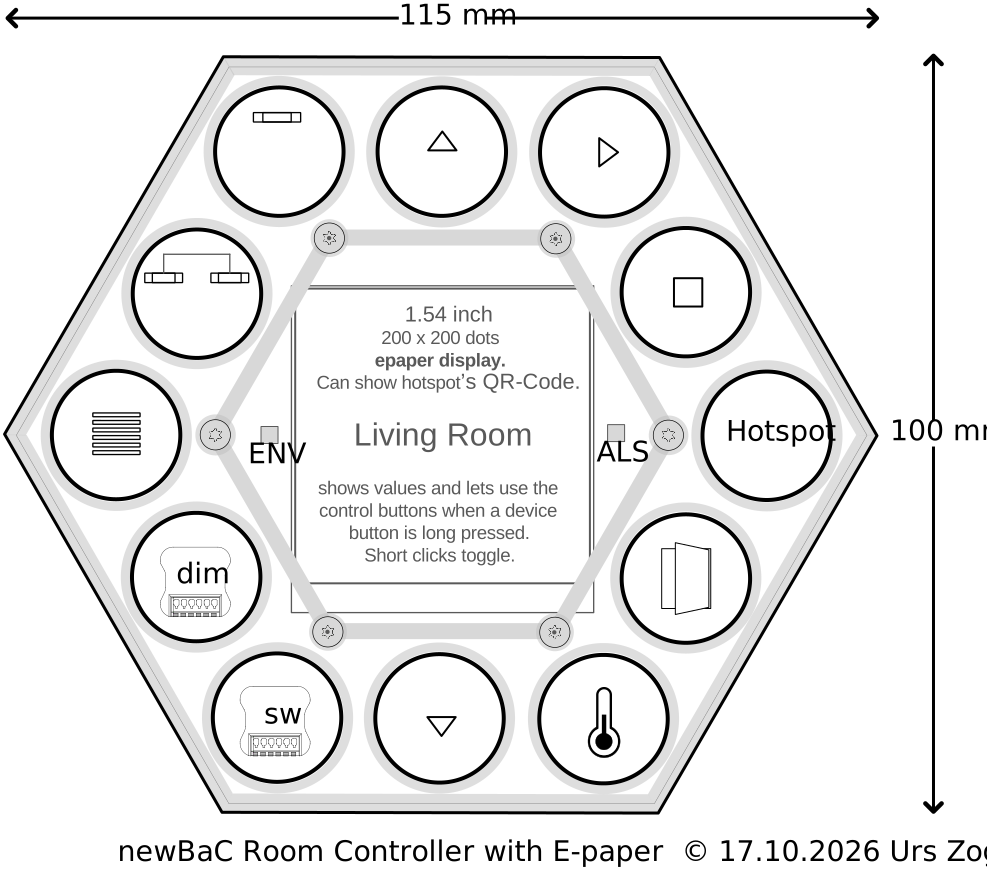
newBaC Hex Room Controller with E-Paper
Wall-integrated infrastructure device combining room control, sensing and optional
gateway functionality in a single unit.
The Room Controller communicates wirelessly via Thread IPv6 with the corresponding
actuator devices, reducing installation cost and complexity while accelerating project execution.
All newBaC devices are powered directly from a 24 V DC DIN-rail power supply and operate
as always-active Thread Routers supporting the infrastructure mesh.
Function:
Wall-integrated user interface for lighting, shading, power, media and climate control.
Powered via 24 V DC to support the infrastructure mesh as an always-active Thread Router.
Optional additional controllers for desks, kitchens or workspaces may alternatively be
powered via USB-C PD. Context-sensitive E-paper user interface:
The E-paper display is activated only when additional feedback or interaction is required.
Depending on the selected function, it temporarily presents control values, settings,
notifications, climate information or hotspot access data. The QR code for the temporary
setup hotspot can be displayed directly on the E-paper. Thread-RSSI-based presence detection:
By evaluating RSSI relationships only between infrastructure devices assigned to the same
room or area, newBaC enables privacy-friendly occupancy detection and lighting automation
without dedicated presence sensors.
Optional system role:
Thread Border Router with optional gateway capabilities and local automation logic.
Commissioning, diagnostics and tenant handover are supported via the temporary WiFi hotspot.
Summary:
The device provides a familiar physical user interface for the connected apartment,
combining control, sensing and network intelligence directly within the wall installation.
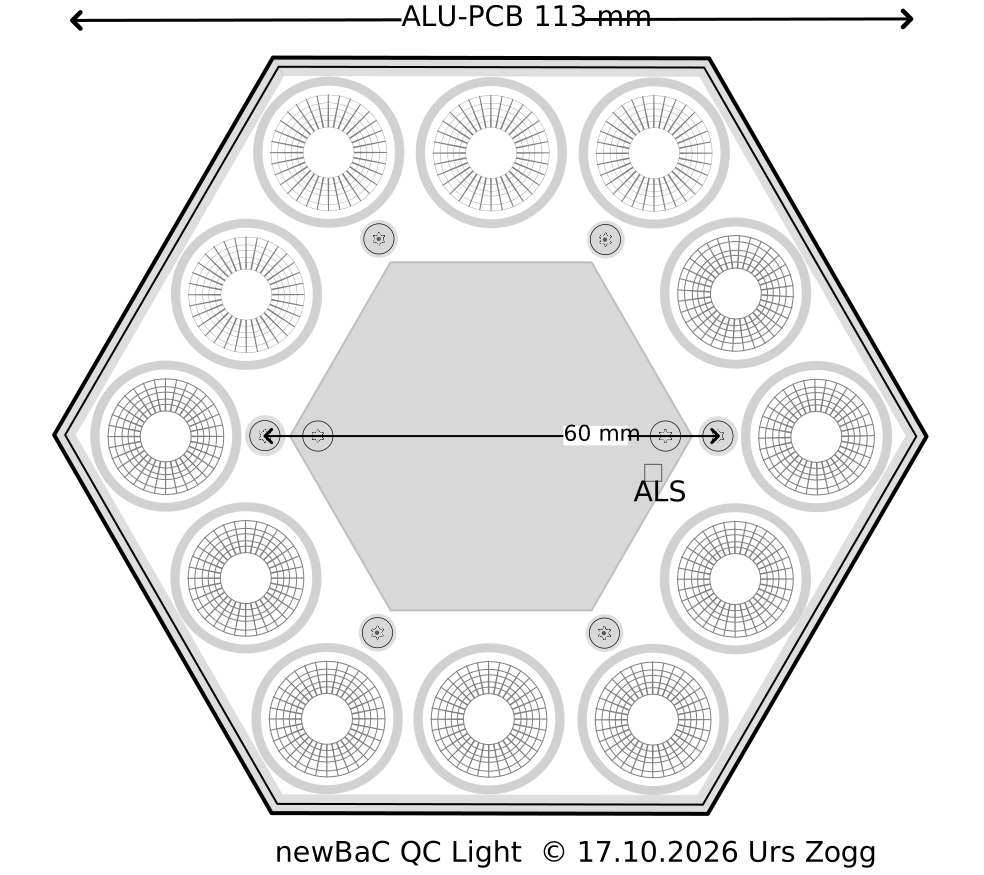
newBaC QC Light
All light elements are interconnected and mounted to the ceeiling via a PCB.
This PCB is powered with 24V DC via a light box.
Function:
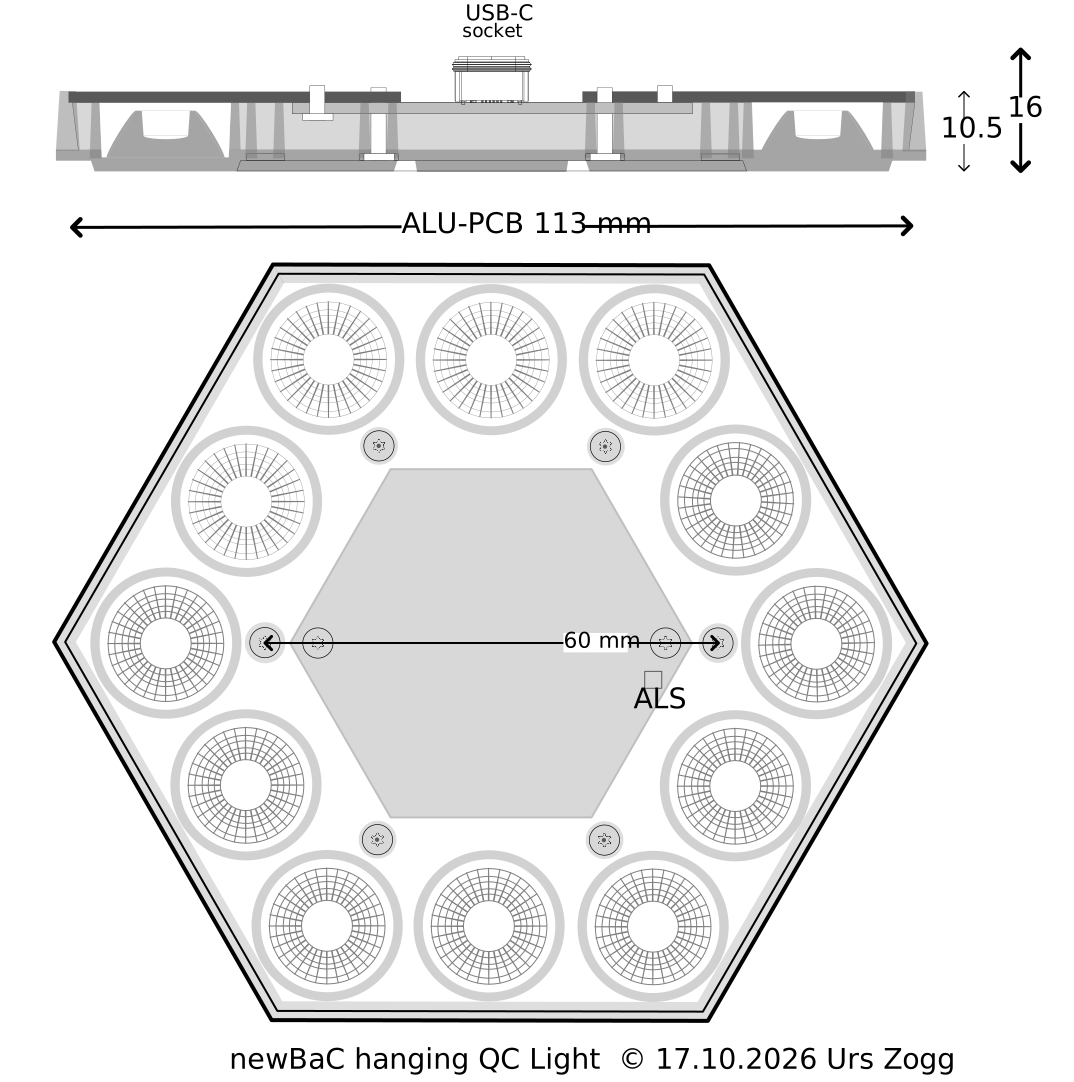
High quality lightning device with twelve LEDs with CRI >90.
Two white light LED strings, each with six 3000K resp. 4000K LEDs are selectable and dimmable via Matter
over Thread.
Powered via 24V DC. For mass usage in new buildings, all components can be labeled and pre-configured
according the plan of the architect or the lightning planner.
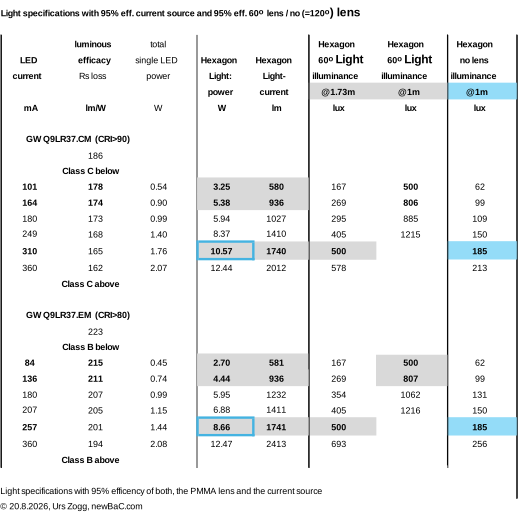
60 degrees lenses bring 500lux illumination on the working table:
The lightning device has 12 lenses to focus the light for high illumination on working surfaces.
For an illumination of 500lux @1m distance, the lightning device needs to emit a light current of 580lm.
The same illumination of 500lux @1.73m distance is possible with 3 times 580lm. This is the reason, why the
Hexagon has six LEDs compared to the 2 LEDs of the minimalistic hanging light - for both, warm and cold light.
Power controlled and optimised for luminous efficacy:
The lightning device contains a precise power meter and can be setup for the maximum power.
One LED delivers one sixt of the power and has the luminous efficacy related to one sixt of the total
light power. During further PWM dimming, the luminous efficacy remains constant.
Quality controlled:
The lightning device is designed for ceiling surface mounting and contains a precise temperature meter which is
used to control the maximum LED temperature below 65 degrees. This leads to a lifetime of 100'000 hours.
Setup:
The lights are easily setup using newBaC Hexagon's hotspot with a mobile (see demo step 3).
For mass usage in new buildings, the lights come normally fully set up via the electrican or the integrator.
Prepared for Voice control:
If the device is used with an extension to Apple Home, Siri can address directly the color of the
frame or the light name indicated on the switch.
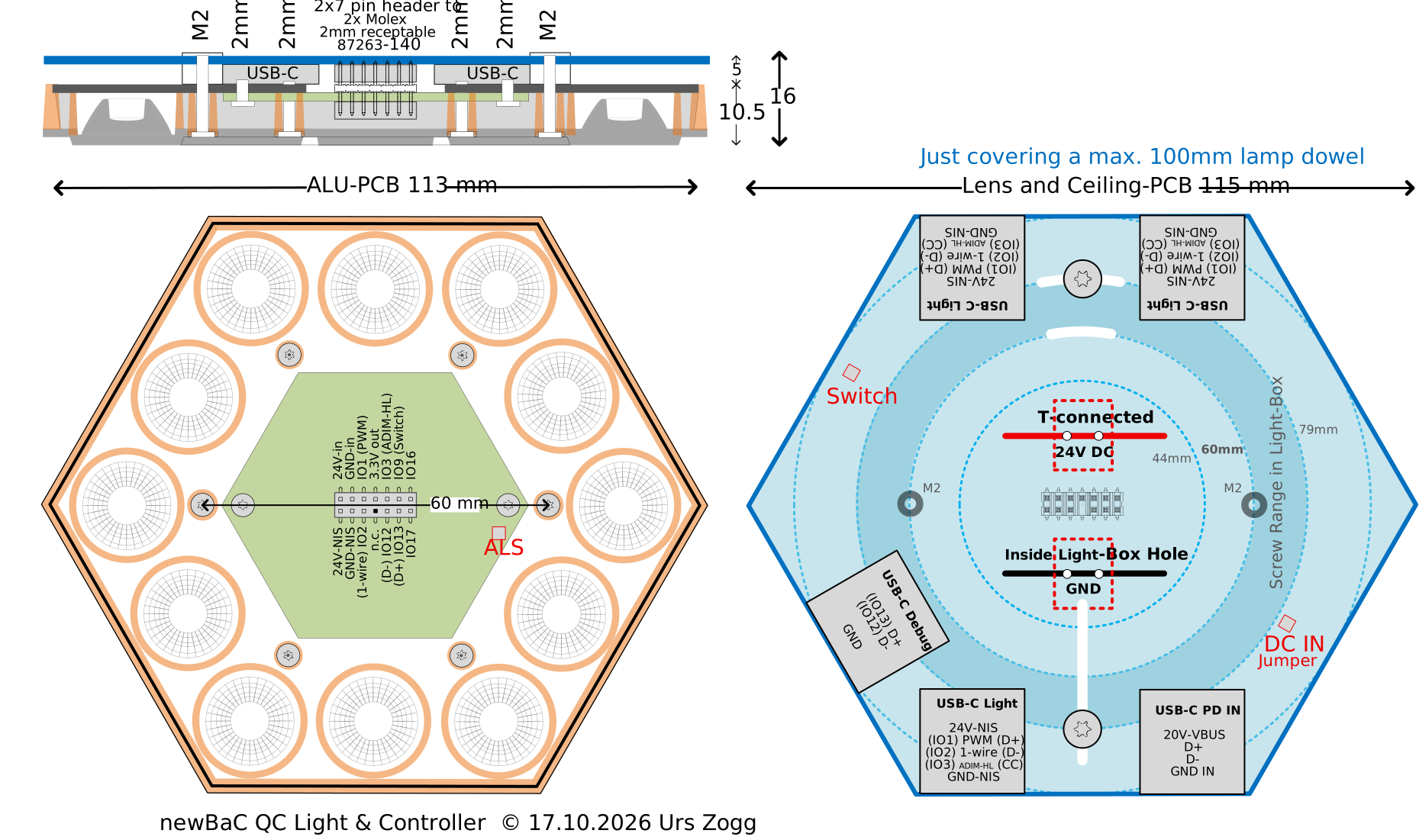
newBaC QC Light and Controller
Ceiling- or wall-integrated infrastructure lightning device which allows to control up to 3 additional
lights. Such lights can be additioal extending ceiling- or wall- Hexagons connected via USB-C cables or
hanging Hexagons above the working table.
The mounting PCB should be screwed to the outer plastics donut of the lamp box (within a diameter
of 60mm to 79mm) to avoid that the screws reach the beton.
The 24V power connection is coming uninterrupted from the DIN-Rail and is going directly to the next
lamp socket. No deviations to wall switches. Just a pair of T-sockets must be pressed onto the GND and
24V wires and be put on the two terminals of the ceiling light. No cutting, no isolating of wires.
Even homeworkers could do this easily.
Function of the light-controller:
Delivers four ports with 24V DC power plus Matter controlled PWM and ADIM signals for dimming plus
control signals to select one of up to four LED-strings.
Quality controlled:
The light controller regulates the temperature of the ODM partner's lights to reach
a long lifetime with a maximum LED temperature.
Setup:
A controller is easily setup using the newBaC light-controller's hotspot with a mobile
(and added as a light according demo step 3).
For mass usage in new buildings, the lights and the switches come normally fully set up
via the electrican or the integrator.
Prepared for Voice control:
If the device is used with a newBaC gateway extension to Apple Home,
Siri can address directly the color of the mounting PCB or the printed name on the switch.
Of course, a new light controller could be added as a Matter over Thread light directly to Apple home,
if it shound not become an infrastructure device.
newBaC hanging QC Light
Slim lightning devices for tables are used with low power per LED to increase their efficiency.
Hanging lights with 60 degrees lenses lead to very efficient working light:
Our light module with 60 degres PMMA lenses is hanging 1m above the table surface and
delivers 500lux bright light around 1m2 area from 3.7W power. In a high quality of CRI>90.
We suggest two such 60 degrees bulbs for a 2m*1m table and 3 bulbs for a round table with 1.5m diameter.
This can be perfectly implemented with a single light controller above / near the table.
Quality and safety controlled:
The light controller measures and regulates the temperature of the hanging light modules to reach
a long lifetime with a maximally allowed LED temperature.
See the integrated U1 chip in our reference design.
Light designers can use thermically more critical design material, like textiles, paper or wood.
They must programm the maximally allowed temperature inside the module using a light controller.
Setup:
The USB-C bulbs belong to their controller and must not be setup by the user.
If the device is used with an extension to Apple Home, Siri can address the light alternatively
directly via the color of the ring of the controller.
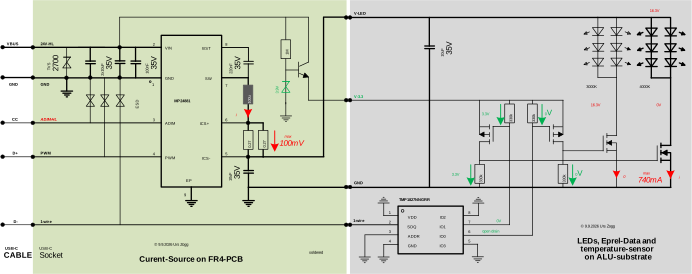
newBaC QC-Bulb Reference Design
The following schematic is used in both, the "newBaC QC Light" and the "newBaC hanging QC Light"
and uses a USB-C interface described under "newBaC Hex Light and Controller".
This open and universal Interface for bulb- and light-designers lets ODM partners integrate their lights
or bulbs to the newBaC light controller.
Up to 60W can be used behind a 24V e-fuse in the "newBaC Hex Light" for the ceiling light and the hanging
lights together; their power can be controlled independently.
Focus to the core competences:
ODM partners can focus entirely on their core competencies: product design and market access.
No deep expertise in Thread, Matter or system integration is required.
Function of the USB-C connection:
Delivers newBaC controller's 24V DC from a DIN-Rail power supply plus a Matter controlled PWM
signal for dimming. Additionally, a 1-wire control bus lets select one of up to four LED-strings,
measure the LED chip temperature and access the memory of the 1-wire chip. The ADIM-signal
controls the maximum light power without dimming.
Power controlled and optimised for luminous efficacy:
The "newBaC Hex Light" contains a precise power meter and can be setup for the maximum power.
One LED delivers one sixt of the power and has the luminous efficacy related to one sixt of the total
light power. During further PWM dimming, the luminous efficacy remains constant. ODMs set the requested
power in the memory of their devices.
QC means Quality controlled:
The light controller regulates the temperature of the ODM partner's lights by dimming to a specified
LED temperature limit. This way, the specified lifetime is warranted and not just a marketing value.
Memory usage in newBaC- and ODM-lights:
The memory stores device-ID, name, white color temperature values, maximum temperature, configured
light power without dimming, dimming ratio for a specified illuminance plus more important EPREL data.
newBaC Development Architecture
Infrastructure-based system combining Thread networking,
controlled Matter integration and a permanent gateway layer.
Primary Gateway Device
Role:
Permanent infrastructure anchor providing Thread border routing,
Matter bridging and application-layer control.
Responsibilities:
• Thread Border Router (always active)
• Matter Fabric participant (single integration point)
• Application Layer Gateway (ALG)
• Storage of installation configuration
• Commissioning via temporary WiFi hotspot
Key principle:
The gateway is the only interface between external ecosystems
and the internal Thread network.
Network Architecture
External Matter systems (Apple Home, Home Assistant)
connect exclusively through the gateway.
Data path:
Tenant System → Gateway → Thread Mesh → Devices
The Thread mesh infrastructure remains independent
of tenant-specific configurations.
Operating Modes
Normal mode:
Thread active, gateway active, WiFi disabled
Commissioning mode:
Activated via long button press;
temporary WiFi hotspot for setup and debugging
Reset mode:
Tenant-specific Matter configuration removed and original installation state restored
Configuration Model
Factory configuration:
Defines installation-specific mapping and system structure
Runtime configuration:
Stores tenant-specific Matter Fabric and session data
Reset behavior:
Runtime configuration is cleared
Factory configuration is preserved and restored
newBaC devices can be paired via QR-codes as standard Matter over Thread devices.
Additionally they support commissioning before installation in new buildings plus faster pairing
without Bluetooth during installation, if the gateway is already choosen, pre-commissioned and installed.
This is provided via a temporary WiFi hotspot available at any newBaC device. See demo step 2.
Commissioning Mode
Activation:
Long press (UP + DOWN) or the SETUP switch activates a temporary WiFi hotspot.
Access:
Direct local connection via mobile or laptop (like in a hotel, e.g. to http://192.168.26.1).
Behavior: Thread network remains active, Gateway remains operational,
WiFi used for local interaction.
Commissioning Data (JSON-Files)
"Factory-Data" factory.json, in any newBaC-devices:
• Device-ID
• Hardware Type
• Matter DAC
• QR-Code "Electrician's-Data" house.json, pre-provisioned in and with the selected gateway-device.
May be retieved from the gateway and securely be transported via Electrician's mobile to
an optional secondary/ standby gateway:
• Home-ID
• Rooms
• Sceenes
• Automations
• Device Registry "Commissioning Data-File" device.json, retrievable from the gateway to be used via Electrician's mobile
for any new devices. The devices load this JSON-file via their hotspots:
• Home-ID
• Gateway-ID
• Tread Credentials
• Time Stamp
• Signature
Available Tools
System monitoring:
Gateway status, Thread connectivity and Matter integration.
Network inspection:
Discovery and state of all Thread devices.
Device mapping:
Switch, controller and light relationships.
Manual control:
Testing of lighting and control functions.
Commissioning:
Matter pairing, device integration and reassignment. See demo step 3.
OTA via the Hotspot:
Firmware update for infrastructure devices via the hotspot and the Mobile.
Failover Gateway:
Backup the gatewy configuration and provision a failover gateway via the Mobile.
Tenant management:
Fabric removal and WiFi QR code regeneration. See demo step 5.
Configuration:
Restore factory setup and verify installation mapping.
Buildings last for decades. Technologies change every few years. newBaC transforms
smart-home functionality from a tenant-specific feature into a permanent building
infrastructure that remains valuable throughout the entire life cycle of a
residential building.
From Smart Homes to Smart Buildings
Traditional projects combine separate systems for building automation, door
communication, smart home, metering and future digital services.
newBaC introduces a common Building Directory Service (BDS) and a shared
building infrastructure, allowing multiple technologies to coexist and evolve
without redesigning the building.
Building Assets
Building Directory Service (BDS): The digital building model, which shows
• buildings, floors, apartments, rooms/parking-spaces/hobby-rooms, devices
• tenant names
• devices with roles, relations, scenes, automations
• states, where events plus state changes are both published via a MQTT-Server
• accounting newBaC Access Controller: Door communication, SIP voice services, access control
and connection to the building backbone.
newBaC Apartment Controller: Matter Controller, Thread Border Router, local
automation and tenant services within the apartment.
Investor Benefits
Lower Installation Cost: Shared infrastructure for lighting, shading, access
control, alarms and future services.
Lower Operational Risk: The infrastructure remains unchanged during tenant
turnover.
Higher Property Value: Digital services become part of the building asset rather
than a temporary tenant installation.
Open and Future-Proof: Integration of KNX, Matter, Thread, SIP and future building
technologies through a common architecture.
Tenant Lifecycle: Tenants bring their preferred ecosystem, applications and
devices. The building keeps its infrastructure. New tenants can move in without
redesigning, rewiring or recommissioning the original installation.
Strategic Vision: Smart home is no longer a feature. It becomes part of the building
infrastructure.
Contact for ODMs
newBaC provides the Matter/Thread PCBs with Switch / Light / Controller / I/O-Ports Options.
Founder's first smart home project was 60 years ago.
His mother had to work sometimes over lunch time as well, because the father died early
and she had to earn the money for the family.
Thus the mother prepared the lunch for the three children in the morning.
And the eldest, the founder made an oven controller, which had to start the oven at 11:00.
Here is a recipe of founders's mother for the described use-case: